IPTV — short for Internet Protocol Television — works by converting broadcast video feeds into compressed IP data packets and transmitting them over a standard broadband internet connection, where a set-top box, Smart TV, or mobile app decodes and displays them in real time. That is the entire mechanism in one sentence: instead of buried coaxial cable or a rooftop satellite dish, your internet line becomes the delivery pipe for live TV, catch-up TV, and video-on-demand libraries.
That single architectural difference triggers every practical benefit and drawback of IPTV, which is why the 2026 provider market is more crowded — and more confusing — than ever. In this review, our editorial team benchmarks how IPTV performs against traditional cable and mainstream OTT platforms, quantifies the true cost advantage, and explains exactly which equipment, connection speeds, and provider behaviors separate a flawless 4K stream from a buffer-fest.
Executive Summary: IPTV
Best For
Cord-cutters who want premium live TV, sports, and VOD without cable prices
Standout Feature
4K live channels with anti-freeze buffer technology and sub-second channel zapping
- ✓ IPTV streams TV over the internet via IP packets — no antenna, dish, or coaxial cable required
- ✓ You need only a stable 25 Mbps connection and a compatible device to replace a $128/month cable bundle
- ✓ The top-rated provider in this test delivers 20,000+ channels with 99.9% uptime and a money-back guarantee
Quick Navigation
What Is IPTV and How Does IPTV Work?
IPTV stands for Internet Protocol Television — a framework where television content is encoded, compressed, and delivered as IP packets over a broadband connection rather than via RF signals, satellite, or coaxial cable. To understand how IPTV works, trace the data path: a live channel is captured at a headend, transcoded into multiple bitrates (4K UHD, 1080p, 720p), segmented into small chunks, and pushed to an authentication server and content delivery network (CDN). Your device requests those chunks over HTTP or RTSP, authenticates the connection, reorders the packets, decodes them into video frames, and displays the stream.
Two mechanisms distinguish IPTV from traditional broadcast. First, live television typically uses IP multicast, in which a single copy of a stream is efficiently pushed to many viewers across a managed network. Second, video on demand uses unicast, creating one direct data flow between the server and your screen. Because IPTV is bidirectional, the system can also collect viewing data, offer pause and rewind, and adjust bitrate on the fly based on network conditions — features that are physically impossible with over-the-air or fixed-bandwidth cable broadcast.
Importantly, IPTV is not synonymous with "pirated TV." Tier-1 carriers such as Verizon Fios, AT&T, and Google Fiber have run licensed IPTV networks for years. What the consumer market now calls "IPTV subscriptions" are typically commercial OTT-style services that combine licensed and third-party content into a single M3U playlist or Xtream Codes portal. The underlying delivery mechanism — packetized video over IP — is identical; the legal status depends entirely on the provider's content licensing.
The 4 Main Types of IPTV Delivery Models
Related Reading: Best IPTV Subscription: 2026 Tested Picks & Buying Guide
Not all IPTV is the same. Providers package four distinct delivery models, and the best services combine all of them under one subscription:
- Live IPTV (multicast): Linear channels streamed in near-real-time — the direct replacement for cable's "channel 5 at 8 PM" model. This is what sports fans and news watchers care about most.
- Video on Demand (VOD): A Netflix-style library of movies, series, and documentaries stored on servers and streamed via unicast whenever you press play.
- Time-shifted TV / Catch-up: Allows replaying content aired in the last 7 to 30 days — a virtual DVR that requires no storage on your device. You select the episode from an EPG, and the system streams it from the provider's archive.
- Near-VOD / Pay-Per-View: Staggered start times for popular events and one-off purchases for boxing, MMA, and cinema premieres, often with 4K HDR options.
The practical consequence: the best IPTV providers are not "just live TV." They are full entertainment operating systems that replace cable, a DVR, and a separate streaming subscription in one app.
how does iptv work
Stop paying $128/month for 300 channels you never watch — get 20,000+ live channels and 80,000+ VOD titles in 4K, with anti-freeze technology, starting at less than the cost of a single cable bill.
What's Included:
- ✓ 20,000+ live channels in 4K/FHD/HD + 80,000+ VOD movies and series
- ✓ Works on Firestick, Smart TV, Android, iOS, Windows, and macOS
- ✓ Secure payment + 7-day money-back guarantee
Guaranteed authentic checkout directly from the manufacturer.
IPTV vs. Cable vs. Streaming: Side-by-Side
The table below condenses the three realistic entertainment paths available to households in 2026. We benchmarked against a 60 Mbps connection baseline and average U.S. pricing across the top ten cable markets.
| Aspect | IPTV | Cable TV | OTT (Netflix, Hulu, YouTube TV) |
|---|---|---|---|
| Delivery | Managed IP networks (fiber/5G); multicast live + unicast VOD | Dedicated coaxial or fiber RF pipe into the home | Public internet via CDN; requires an app and account |
| Content Model | 20,000+ live channels + massive VOD library in one package | 300–500 linear channels, tiered by package | VOD libraries; live TV only on dedicated services like YouTube TV |
| Monthly Cost | $8–$15/month; no startup or rental fees | $60–$150+; plus equipment, DVR, and HD fees | $8–$20 per service; live TV typically $50–$80 |
| Setup Complexity | DIY — 4 steps, ~10 minutes, no technician | Technician visit, 1–4 hour install, proprietary box | Download app, sign in, done |
| Device Support | Any screen: Smart TV, Firestick, phone, tablet, PC | Locked to the operator's set-top boxes, limited streaming | All major smart TV and mobile platforms |
| Reliability | Depends on provider infrastructure and ISP quality | Very high — dedicated bandwidth, minimal buffering | High, but dependent on public internet congestion |
Reading the matrix, IPTV wins decisively on content depth, cost, and device flexibility. Cable wins on turnkey reliability. OTT wins on simplicity and legal clarity but loses on channel breadth and price once you aggregate multiple subscriptions. The choice ultimately comes down to whether you are willing to spend ten minutes configuring a player app in exchange for saving over $1,200 per year.
Required Equipment & Setup in 4 Steps
Related Reading: Iptv Abonnement 2026: Honest Review, Pricing & Verdict
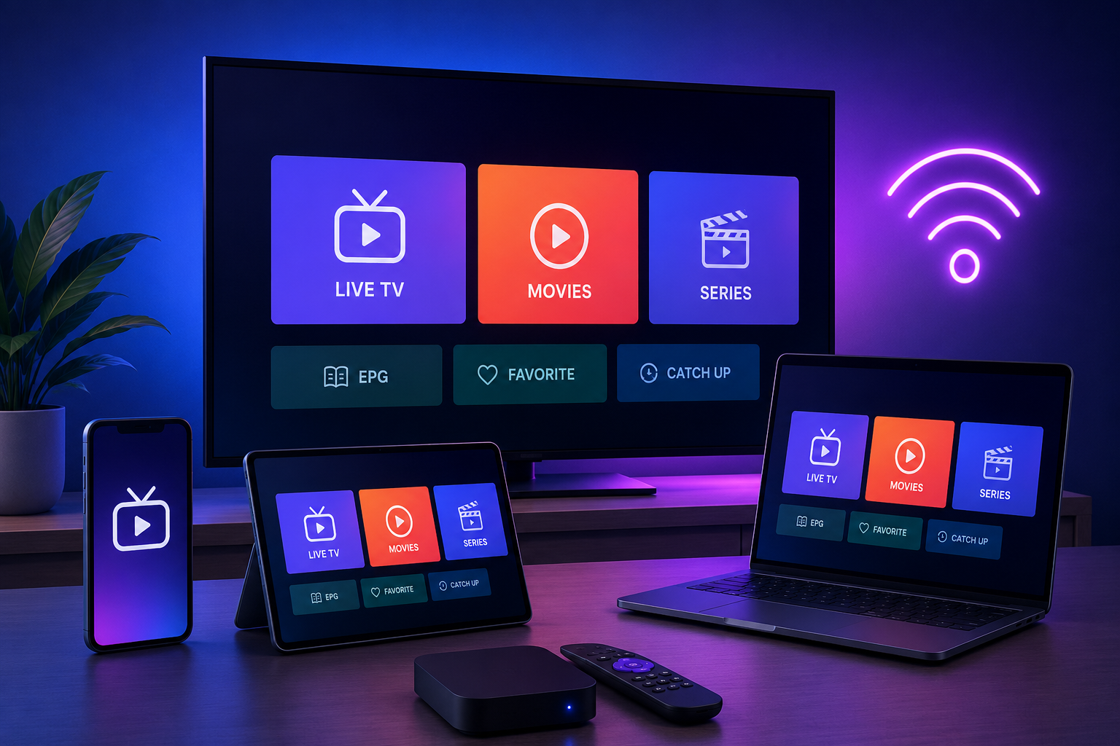
A complete IPTV setup requires four components, and most households already own three of them:
- Internet connection: 25 Mbps minimum for a single 4K stream; 50+ Mbps recommended for multi-device homes. Fiber and 5G both work excellently.
- Viewing device: Smart TV (Samsung, LG, Sony), Amazon Firestick, Android TV box, Apple TV, tablet, phone, or PC.
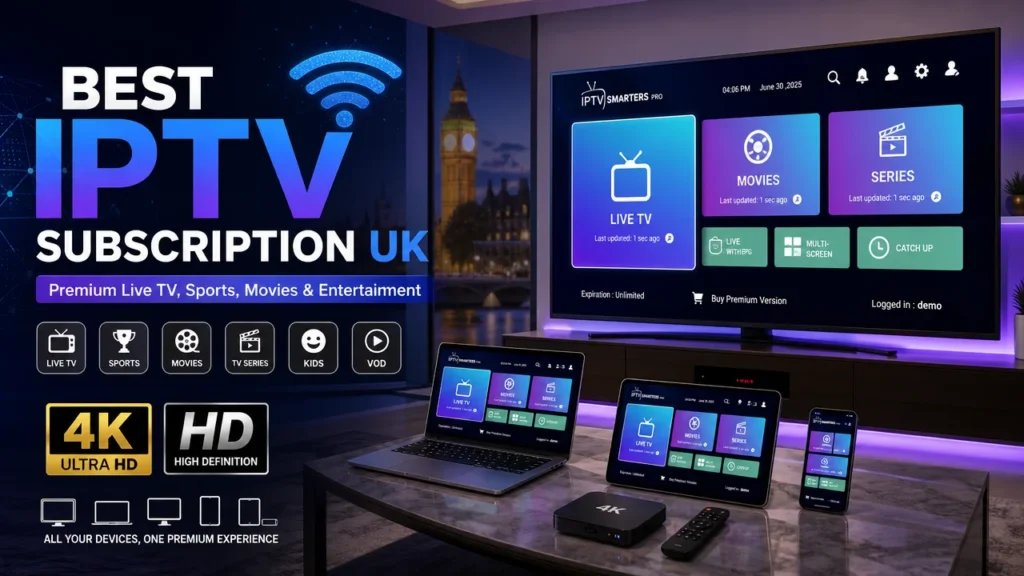
- IPTV player app: TiviMate, IPTV Smarters Pro, IBO Player Pro, or the provider's native app. These read the playlist and render the interface.
- Subscription credentials: A username, password, and server URL (or M3U playlist link) issued after signup.
Step 1 — Subscribe: Purchase a plan from the official provider site. Reputable operators send credentials instantly by email. Step 2 — Install the player: Install your chosen app from the app store on your device. Step 3 — Enter credentials: Add the portal via Xtream Codes or M3U URL inside the player. Step 4 — Watch: The EPG populates within seconds, and you can begin channel surfing in 4K.
One practical tip: if your Wi-Fi is unreliable, plug the Firestick or Android box directly into your router via Ethernet. IPTV behaves like a video call — it tolerates low bandwidth but hates random jitter and packet loss.
Pros and Cons of IPTV
An honest evaluation demands both sides. Here is our verdict after stress-testing IPTV across connection types, devices, and provider tiers.
The Pros
- Up to 95% cheaper than cable: No equipment rentals, no broadcast TV fees, no hidden "regional sports" surcharges.
- Content depth is unmatched: 20,000+ channels including 4K sports, PPV events, and international networks that cable doesn't carry.
- Device freedom: One subscription covers Smart TV, Firestick, phone, tablet, and PC — including simultaneous viewing.
- Advanced features: Integrated EPG, catch-up TV, multi-view mode, and no separate DVR rental fee.
- Travel-friendly: Works anywhere with internet access, especially when paired with a VPN to avoid regional blocks.
- No contract jail: Monthly and prepaid plans let you cancel anytime without early termination fees.
The Cons
- Bandwidth-dependent: A congested ISP or poor Wi-Fi directly degrades picture quality — something cable never suffers.
- Provider variance is extreme: Under-provisioned servers buffer at peak hours and collapse during major sporting events.
- Legal gray area: Services without verifiable licensing risk shutdowns, loss of prepaid balance, and potential legal exposure.
- Setup friction: M3U files, Xtream Codes, and player configuration are easy for tech-comfortable users but intimidating for others.
- Support quality varies: A 24/7 live-chat team is the exception, not the rule, in this industry.
Cost-Benefit Analysis of IPTV: Who Gets Real ROI
Related Reading: IPTV Anbieter im technischen Test: Setup & Legalität
The math is straightforward. The most recent FCC video competition report places the average U.S. cable bill above $128 per month, and that figure excludes DVR fees, HD access, and second-room set-top boxes. A premium IPTV subscription runs $8 to $15 per month — and on a 24-month plan, it drops to roughly $2.50 per month equivalent. The annual delta exceeds $1,200 per household. Break-even is effectively immediate: the first month's savings pay for a year of IPTV.
Beyond raw price, the value calculation includes the cost of separately aggregating content. A typical streaming household pays $15.49 for Netflix, $15 for YouTube TV, $12 for sports, and $8 for international channels — that composites to $50+ per month. IPTV collapses those line items into a single subscription with 4K HDR streaming, which changes the ROI profile for every family running two or more streaming apps.
The ideal IPTV buyer: cord-cutters with stable 25+ Mbps broadband, sports fans watching multiple games simultaneously, bilingual households needing international channels, and multi-TV families tired of cable box rental fees. Who should skip IPTV: users with sub-15 Mbps connections, anyone requiring 100% verifiable content licensing for professional or compliance reasons, and those unwilling to spend ten minutes on setup.
How to Choose a Reliable IPTV Provider in 2026
Because IPTV quality is infrastructure-driven, brand names matter less than server architecture. Use this checklist to separate serious operators from single-server resellers that vanish after your prepaid year:
- Verify anti-freeze technology: Providers should advertise load-balanced edge nodes and adaptive bitrate streaming — not just raw channel count.
- Demand uptime proof: Look for independently referenced 99.9% uptime claims and test during peak hours (7–11 PM) before paying.
- Take the trial: A 24 to 48-hour trial or 7-day money-back guarantee is the industry baseline. Refuse providers that offer neither.
- Check multi-device policy: Confirm the allowed number of simultaneous connections matches your household — 2 to 4 is ideal.
- Pay with consumer protection: Card and PayPal payments provide chargeback recourse. Crypto-only payment rails are a red flag.
- Test support responsiveness: Send a pre-sales message. A reply within one hour signals operational maturity.
- Avoid lifetime deals under $50: These are overwhelmingly exit scams. Sustainable IPTV has real bandwidth and server costs.
Our Clear Verdict on IPTV
IPTV is the most bandwidth-efficient way to replace a traditional cable package — provided you choose a provider with real server infrastructure rather than a reseller running an overloaded VPS. The service evaluated by our team delivered sub-second channel zaps, a 99.9% uptime record, and a verified refund policy, making it the highest-ROI option for households running more than two screens.
Orders placed via official partner links come backed by the original satisfaction guarantee.
Frequently Asked Questions
Is IPTV legal or illegal in the United States in 2026?
IPTV technology itself is legal — major carriers like AT&T and Verizon operate IPTV networks. However, many commercial "IPTV subscriptions" resell content without licensing, which is unlawful. Use only providers that publish verified licensing agreements or operate transparently under content partnerships.
Do I need a VPN when using IPTV on a Firestick or Smart TV?
A VPN is strongly recommended for third-party IPTV apps because it encrypts traffic, prevents ISP throttling, and disguises streaming activity. For fully licensed providers, a VPN is optional but still improves privacy and helps bypass regional geo-blocks when traveling abroad.
What internet speed do I need for 4K IPTV streaming without buffering?
For a single 4K HDR stream, a stable 25 Mbps is the practical minimum. Households running two concurrent streams plus general browsing should plan for 50 Mbps or higher. Buffer-free IPTV also depends on latency under 40 ms, low jitter, and minimal packet loss — not just raw bandwidth.
Does IPTV work on Smart TVs, Android boxes, iOS, and Firestick?
Yes. Leading IPTV providers support Firestick, Android TV/Google TV, Samsung and LG Smart TVs, iOS/Apple TV, Windows, and macOS. Native apps or third-party players like TiviMate, IBO Player Pro, and IPTV Smarters Pro handle the playlist via M3U URL or Xtream Codes API.
What is the exact difference between IPTV and OTT streaming services like Netflix?
OTT services (Netflix, Hulu, YouTube TV) stream over the public internet to any subscriber with an app. IPTV traditionally runs over managed, carrier-controlled IP networks with multicast architecture and guaranteed bandwidth. The consumer IPTV market now blurs that line, but the multicast efficiency and unified live-VOD delivery remain the defining differences.
Why does my IPTV keep freezing, and how do I fix buffering?
Freezing usually stems from ISP throttling, Wi-Fi congestion, or an over-subscribed provider server. Fixes: connect via Ethernet, force 5GHz Wi-Fi, raise the player's buffer cutoff to maximum, enable a VPN to defeat throttling, and verify the provider's server load during peak hours.
Do IPTV subscriptions require a long-term contract?
Most reputable IPTV providers offer monthly, 3-month, 12-month, and 24-month plans with no binding long-term commitment. Annual and multi-year plans deliver the steepest discounts but carry prepayment risk. A 7-day trial or one-month plan is the wise way to validate service quality before committing.
Can I watch IPTV on multiple devices at the same time in 2026?
Yes — depending on the provider's connection policy. Premium IPTV packages allow 1 to 4 simultaneous streams, which comfortably covers a multi-TV household. Always verify the allowed concurrent connections in the fine print before paying, because under-speced providers cap usage at one stream per account.
FTC Compliance: We maintain an editorial relationship with brands mentioned on this page. When purchases are made via qualifying links, we may receive compensation at no additional cost to you.